In Marguerite de Bourgoing's article Hip Hop Goes Transmedia Seven Laws, she talks about 7 keys to success while creating music by sampling. The bulk of the article speaks about the 7 laws:
1)Spread your brand: open mic- This explains how reaching a mass audience using tools such as the web can be effective to get your music out their and heard. Existing in a community of people looking for your music and others like it is important.
2)Keep it real: be authentic and marketable- Be unique with your sound and look. Dress edgy as well as sound edgy and people will flock to you, but don't be edgy to the point where no one likes you.
3)Be the change you want to be- Don't conform to the social or media norms, instead be the sound that you want.
4)Collaborate- Mixing sounds with different artists gives a dynamic edge that listeners generally respond positively to. She also states that having "beef" with other artists can create interesting music as well.
5)It ain't hard to tell- Rappers are great story tellers. Creating a transmedia story can be difficult because your sampling music. Create a show for your audience that is engaging and entertaining.
6)It's a mans world but would be nothing without a women- Women are completely out numbered in the hip hop industry as well as DJing. Having a women could appeal to a large missing desire that the mass audience desires.
7)We are scholars before colleges- Hip Hop has a deep and long history, be sure to embrace that and understand its roots.
Some of these points really hit on topics we discussed at the beginning of the semester. Staying within a web community to reach a larger audience is something that many DJ's utilize. It really goes back to the "long tail effect" where now underground music such as transmedia sampling, can be reached by everyone and isn't crowded out by the mainstream music.
Now, touching on the Rhythm Science book by Paul D. Miller. This book seemed really hard to read, it really reminded me of watching the Charlie Sheen 20/20 interview. By the end of the reading I was thinking to myself, "What the hell did I just read". None the less I do feel like I got the jist of what he was saying. In Miller's first section he speaks about how writing keeps himself sane, that it takes him to a higher place, "his own temple". This in essence allows him to create creative and unique forms of music. In his next section Miller speaks on Multiplex Consciousness which is basically looking at ones self from outside perspectives. He transition this concept into the sampling of music by stepping outside of ones self and examining the music from a outside perspective. His final section is about phonography, which is the use of sample sounds to create music. He speaks about rapping is easy to tell a story but using others samples to create a message to your listener.
Making connections between the two articles, both writers really make emphasis about connecting to the audience through the use of story telling. Both mention that it is hard to create a story while sampling music.
Thursday, March 3, 2011

Wednesday, February 16, 2011
(Dtc356 Blog 6) Jenkins Vs. Weinberger
After reading a passage of Jenkins book Introduction: "Worship at the Alter of Convergence" and Weinberger's book Everything is Miscellaneous, I noticed a few main points that Jenkins brought up which connects to Weinberger.
 |
| Henry Jenkins |
Jenkins Main points:
1) Convergence Culture: This concept that Jenkins brings up suggests that people are getting information is being done so on different platforms. For example, people are no longer just getting news from the newspaper, instead they might be getting all of their news from less formal sources.
2) Participatory Culture: This concept suggests that there is a shift in the production of media. Now the general public is producing media and it is no longer just for its previous formal producers.
3) Collective Intelligence: No one knows everything, but everyone knows a little. If we combine everyones knowledge we can get closer to the desired solution.
All of these points line up with the main points of Weinberger. Convergence culture speaks on the part about how organizing data and metadata is more plausible with the innovation of the web. Participatory Culture in a sense is Web 2.0, people can now help organize as a group not an individual (i.e. flickr.com and delicious.com) or help add their own personal knowledge (i.e. wikipedia.org). Participatory culture leads to the concept of collective intelligence, this is also a Web 2.0 concept that Weinberger writes on. All three main points are reliant on one another and without the others each would not exist.
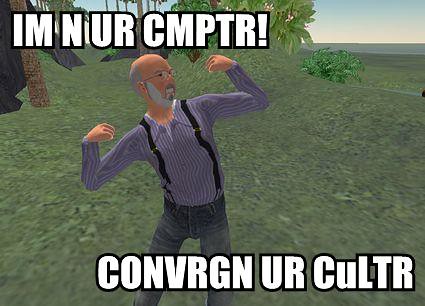 |
| Found this funny pic on the web |
Monday, February 7, 2011
(Dtc356 Blog 5) Implicit meaning
Weinberger, relying on German philosopher Heidegger, says that "the meaning of a particular thing is enabled by the web of implicit meanings we call the world" (170).
What this means to me is that the things in the world are labeled and named after what their uses are. Weinberger uses the example of a hammer, it can be described by its uses, the way it feels when you touch it, and the sounds it makes. Essentially we describe these things by the way we interact with them in our lives.
This relates to the third code in the sense that everything can be described by it's uses differently by its implicit meaning to each individual use. Take a photo for example, several people can be described differently by different people. This describes the way people tag objects for organization in the third order perfectly.
Monster- Kanye West, This is what I picture in my head. The image is organized in a hierarchy of color that this particular song gives me as well as a base reference image.

What this means to me is that the things in the world are labeled and named after what their uses are. Weinberger uses the example of a hammer, it can be described by its uses, the way it feels when you touch it, and the sounds it makes. Essentially we describe these things by the way we interact with them in our lives.
This relates to the third code in the sense that everything can be described by it's uses differently by its implicit meaning to each individual use. Take a photo for example, several people can be described differently by different people. This describes the way people tag objects for organization in the third order perfectly.
Monster- Kanye West, This is what I picture in my head. The image is organized in a hierarchy of color that this particular song gives me as well as a base reference image.

Tuesday, February 1, 2011
(DTC356 Blog 4) Web 2.0 organization
In chapter 5 Weinberger looks at the organization of information in retrospect to it's usability for everyone. He uses an example of Getty's Thesaurus was extremely easy to use for those who are familiar with it but to those who aren't, it is almost impossible to find anything. The categories in which everything is organizes are too simple for the complex topics in which it is explaining and therefore makes it hard to use. The Thesaurus example represents orders 1 and 2 (as explain earlier in a previous blog) there has to be a deciding winner, folder, or category that the information falls into.
Web 2.0 really solves this issue of over generalization of categories. Sites like delicious.com and flickr.com have proven that having a community tag images on their own organizational schemes creates a universal order that organizes metadata in a perfect fashion. This is explained as Weinberger's 3rd order.
Wienberger also gives 4 strategic ways of organization:
1)Tagging- This gives a personal user friendly way to remember how and what some thing is ex.delicious.com where people can tag previous website to remember and for others to discover.
2)Filters-With a large number of people to edit information filtering the information can keep the bad stuff out while maintaining the necessary stuff, it becomes a essential tool for web 2.0 organization. Ex. Wikipedia.com where users can edit one another articles.
3)Everything can be labeled- In completely miscellaneous the only real way to organize is to tag to help find it later.
4)Giving up control- Not one person can organize completely miscellaneous information. Web 2.0 gives use the opportunity to compile and look through data us a reasonable means.
Web 2.0 really solves this issue of over generalization of categories. Sites like delicious.com and flickr.com have proven that having a community tag images on their own organizational schemes creates a universal order that organizes metadata in a perfect fashion. This is explained as Weinberger's 3rd order.
Wienberger also gives 4 strategic ways of organization:
1)Tagging- This gives a personal user friendly way to remember how and what some thing is ex.delicious.com where people can tag previous website to remember and for others to discover.
2)Filters-With a large number of people to edit information filtering the information can keep the bad stuff out while maintaining the necessary stuff, it becomes a essential tool for web 2.0 organization. Ex. Wikipedia.com where users can edit one another articles.
3)Everything can be labeled- In completely miscellaneous the only real way to organize is to tag to help find it later.
4)Giving up control- Not one person can organize completely miscellaneous information. Web 2.0 gives use the opportunity to compile and look through data us a reasonable means.
Wednesday, January 26, 2011
(DTC356 Blog 3) My organized vs your organized
The thing I keep most organized in my life is mostly shaped by my college lifestyle. My clothes unfortunately have not seen the inside of a dresser drawer in years, sad, I know... Because I have been moving in and out of new houses and apartments over my college career, I have found it so much easier to just use the large tub like containers I move them in to contain them over the school year. When the year is over and I move into a new place I simply put the lids back on and throw them in my car. I have specific types of clothes in each tub and this organization is very important to my daily routine. If for some hypothetical reason my clothes were to get mixed up in different tubs I would have a hell of a time finding it when I need it. This could pose potential problems, like for example when I am throwing on clothes 10 minutes before my class starts. Any other person may, and would most likely organize the layout of my clothes differently. The layout of my clothes has no apparent rhyme or reason but has stuck with me over the last couple years. I find it slightly ironic because the lack of justification for order and acceptance of it reminds me of the alphabet and its organization.
Tuesday, January 25, 2011
(DTC356 Blog 2) Organization through Organized ideas
 The first chapter of Everything is Miscellaneous, by David Weinberger discusses the idea of how much we use organization in our daily lives. Weinberger makes reference to alphabetically organizing subjects as completely outdated. He instead thinks the best form of organization has been innovated by Flickr. Users can tag images in a community, when searching for a image the search engine looks through all the tags and picks out those with specific tags. Flickr even takes this to another level not only can the uploader of the image tag categories but it lets other people tag the images as well. Tagging categories in order to organize has proven to be the most effective way to organize subject in order to sort through and find exactly what the user needs.
 |
| Periodic Table of Elements are grouped by the type of elements |
Order 1: We use this type to organize things as they are; we put "silverware in drawers, books on the shelf, and photographs in a album" (19 Weinberger)
Order 2: We organize things with a single tag or group them in a lone category. Weinberger uses a example of photos; a any photo pertaining to the civil war will be under the category "civil war", this includes images such as muskets, cannons, or uniforms that could be in the civil war era. A great example of this is the periodic table of elements
Order 3: This is described as the "digital order" as it was really utilized and innovated on the internet. This concept uses multiple tags on images to help users searching for a specific image will find it easier.
In Chapter 2, Weinberger looks at humans nature to organize things. The alphabet which in any sense of organization will most likely show up, in a sense it is one of the base methods of organization. But, the alphabet itself is completely random in the ordering of the letters. Humans have an innate desire to organize in some fashion. This really got my thinking about why the alphabet is order the way it is, why it has been so adopted by humans even though it has no real organization, and what are other things that have random organization?
Monday, January 17, 2011
(DTC356 Blog 1) Web 3.0 squared times ten billion
 I just got the opportunity to read Tim O'Reilly and John Battelle's article Web Squared, Web 2.0 Five Years On. Before I really get into describing the main points of the article, I will give a little background on the previous article that it's proceeding. O'Reilly's article was describing the concept of Web 2.0 and its effects on the internet. Five years later, he wrote this article once again describing the changes that the web has made.
The main points that I really took away from the article is that firstly the internet is quickly moving from our desktops and laptops and into our pockets. More and more people are utilizing the web through mobile devices. This mobile idea itself increases the possibilities of the web in that the internet applications can be accessed anywhere there is service available. Another important fact that I was able to take away from the article is that the web is becoming increasingly intelligent at a fast rate. We are now interacting with the internet verbally; we are asking it questions and it is able to recognize what we are saying and is capable of giving us an answer, instructions, or the product that we want. The innovation of the Myford touch shows how computers are now listening and even coaching on how to drive more efficiently. It is literally watching the way we drive, analyzing it, and giving us a new way to improve it. We are beginning to get the feeling that the internet is almost becoming a human being...
 The coolest application that has come out is the idea of augmented reality. This concept is that the web can look at the outside world and recognize it. This opens the door for such amazing innovative ideas. Here is the example of Wikitude AR Travel Guide which recognizes traveler landmarks and gives a description of the subject and also other hotspots around the area.
Subscribe to:
Posts (Atom)